Sales books, in my opinion, are one of the most undervalued sales resources of the modern day.
But that does not mean you have to bore yourself by reading countless books specifically about sales.
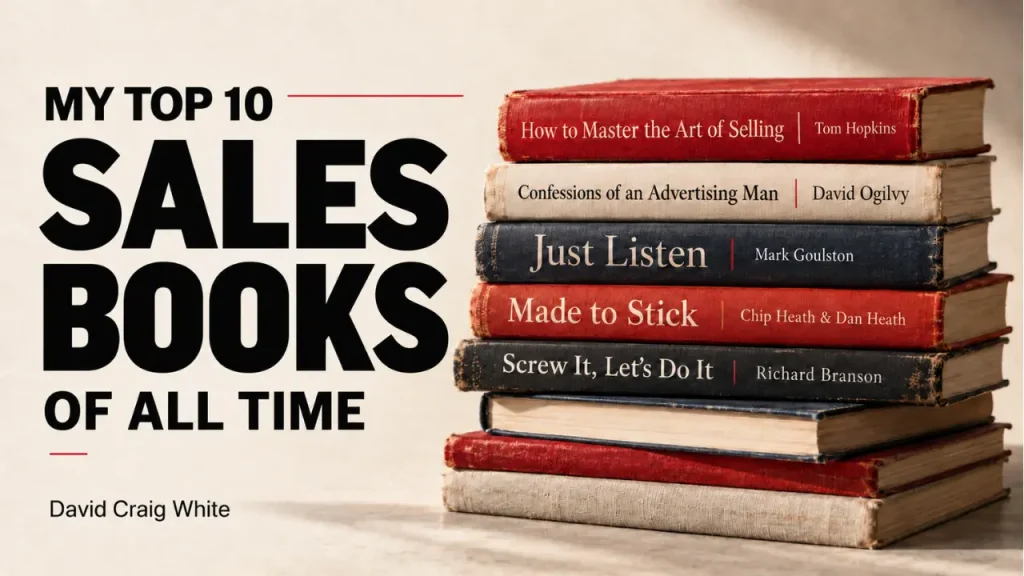
Some of the best lessons I’ve learnt about selling have come from people who have never written a sales book.
A logo designer taught me valuable lessons about charging what you’re worth. An advertising legend changed how I think about winning clients, and a book by Richard Branson gave me the push I needed to start my first company.
In this article, I share my best sales books of all time and explain the advantages of each book, and the impact it had on my sales career.
My Top 10 B2B Sales Books of All Time
None of these books was written specifically for B2B sales, yet all three have influenced my career in sales.
Don’t get me wrong. I love a good sales book.
But once you’ve read a few decent ones and started putting what you’ve learnt into practice, I believe there’s more to gain from broadening your reading than continually revisiting the same sales advice.
Selling involves far more than prospecting, handling objections and closing deals. You need to understand people, communicate ideas, demonstrate value and make good business decisions.
There’s plenty to learn from people outside the sales profession.
1. How to Master the Art of Selling by Tom Hopkins
If I could recommend only one traditional sales book, it would be How to Master the Art of Selling by Tom Hopkins.
I own an original 1980 edition and enjoyed it so much that I bought an updated version years later.
Tom Hopkins is, and always will be my sales hero.
This was the first sales book I ever read back in 2002, and inspired me both in my earlier career as a salesperson and as a leader, coach and sales trainer.
I published Stop Talking Start Selling in 2017, and I’d describe it as a modern day B2B version of Tom’s book on how to master the art of selling.
In fact, the legend himself, Tom Hopkins was so kind to be one of the first to preview the book and provide a wonderful testimonial for the cover.
Hopkins built his career in real estate, but don’t let that put you off if you’re selling software, professional services or anything else.
The fundamentals of professional selling apply across industries, even if the products, customers and sales processes are different.
What I particularly like about this book is its practical approach.
Rather than filling pages with motivational advice, Hopkins gives you techniques and principles you can take away and apply to your own sales conversations.
Of course, some of the examples reflect the era in which it was written. But that doesn’t make the lessons irrelevant.
One mistake I see salespeople make when reading books is trying to copy techniques word for word. I’ve always believed you need to understand the principle behind a technique and then adapt it to your personality, customers and selling environment.
That’s how I’d recommend approaching this book. Read it, find the ideas that make sense for your business, and put them into practice.
2. Just Listen by Mark Goulston
One of the most important skills in sales is listening, yet it’s something many salespeople struggle to do properly.
They’re so busy thinking about their next question, preparing a response or looking for an opportunity to pitch that they miss what the person in front of them is actually saying.
That’s one of the reasons I recommend Just Listen by Mark Goulston.
The book explores how to communicate and get through to people, particularly when they’re angry, upset, resistant or simply unwilling to listen.
Although it isn’t written specifically for salespeople, I found its advice relevant to almost every profession that involves dealing with other human beings.
Think about how often sales conversations become difficult because someone feels misunderstood.
A prospect raises an objection, and the salesperson immediately tries to overcome it without fully understanding the concern behind it.
Sometimes the smartest thing you can do is stop trying to find the perfect response and make a genuine effort to understand the other person.
I recommend this book to salespeople, account managers, customer service professionals and anyone responsible for managing people.
After all, you can’t expect to influence someone you haven’t taken the time to understand.
3. HBR Guide to Persuasive Presentations by Nancy Duarte
I’ve previously described Nancy Duarte as the queen of presentation design, and HBR Guide to Persuasive Presentations is one of the reasons why.
Duarte explains how to structure presentations, communicate ideas clearly and create messages that connect with an audience.
Here’s how I apply that to sales.
I’ve always believed salespeople need to learn how to present a solution, rather than simply demonstrate a product.
A product demonstration might show the customer what your software does, but that doesn’t necessarily give them a compelling reason to buy it.
A good sales presentation should connect your solution to the problems, requirements and business outcomes you’ve already discussed with the buyer.
Your product demonstration should support that message, not replace it.
This becomes particularly important when you’re presenting to senior decision-makers who may have little interest in the technical details of your solution but plenty of interest in what it can achieve for their business.
4. Made to Stick by Chip Heath and Dan Heath
There’s little point delivering a brilliant sales presentation if nobody remembers what you said afterwards.
That’s where Made to Stick by Chip Heath and Dan Heath comes in.
The book explores why certain ideas capture our attention and remain in our memories, while others are forgotten almost immediately.
The authors examine everything from stories and everyday communication to the reasons urban myths become so widely known and remembered.
I found the subject fascinating, particularly when considering how people receive, remember and share information.
Imagine you’ve delivered a presentation to a prospective customer. The meeting goes well, but the person you’ve been speaking with needs to discuss your proposal with several colleagues before making a decision.
You’re not going to be in that conversation.
Your contact needs to remember the important parts of your presentation and explain them to people who weren’t there.
If your message was complicated, forgettable or buried beneath unnecessary information, you’ve made that job much harder.
I’d particularly recommend reading it alongside Nancy Duarte’s presentation book.
Together, they offer valuable lessons on presenting ideas persuasively and making sure the important points are remembered.
5. Confessions of an Advertising Man by David Ogilvy
My introduction to David Ogilvy came through an unlikely source: the television series Mad Men.
After watching the show, I became curious about the real advertising executives who might have inspired Don Draper. My research led me to David Ogilvy, and I soon found myself reading his books.
Confessions of an Advertising Man quickly became one of my favourites.
Ogilvy was a master of advertising, but this book covers much more than writing adverts and creating marketing campaigns.
He shares his thinking on winning clients, managing relationships, communicating ideas and running a successful advertising agency.
As someone who has worked in sales and built businesses, I found those lessons particularly valuable.
One of the biggest reasons I recommend Ogilvy to salespeople is the importance he places on communication.
Whether you’re writing a prospecting email, preparing a sales proposal or explaining your services on your website, the objective is much the same.
You need to capture someone’s interest and give them a compelling reason to consider what you’re offering.
You can have the best product in the world, but if you can’t explain its value clearly, you’re going to struggle to sell it.
I also believe business owners, particularly those running service companies, can learn a great deal from Ogilvy’s approach to winning and looking after clients.
6. Tested Advertising Methods by John Caples
If reading David Ogilvy gets you interested in copywriting, I’d recommend adding Tested Advertising Methods by John Caples to your list.
Copywriting is one of those skills I believe every salesperson should make an effort to develop.
You don’t need to become an advertising expert or spend your evenings writing sales letters.
But you should understand how to communicate in a way that captures attention and encourages people to take action.
Caples explores what makes advertising messages effective, with particular attention to headlines and the words used to attract interest.
The lessons are just as relevant to someone writing prospecting emails as they are to someone creating advertisements.
Think about how many sales emails you receive that begin with a long introduction about the sender’s company, followed by a list of products, features and impressive-sounding claims.
By the time the salesperson finally explains why they’re getting in touch, you’ve probably lost interest.
I’ve always believed good sales communication should get to the point quickly and make it easy for the reader to understand what’s in it for them.
Learning how to write stronger subject lines, clearer messages and more compelling requests can make a noticeable difference to the way you communicate with potential customers.
7. Logo Design Love by David Airey
You might be wondering what a book about designing logos is doing on a reading list for salespeople.
Fair question.
I first came across David Airey when I was looking for someone to design a logo around the time I started my first company.
David was an excellent designer, but his services were well beyond what I could afford.
Although I couldn’t justify hiring him, I became interested in his work and eventually bought his book, Logo Design Love.
I remember finishing it and being particularly impressed by the precision of his sales process.
Here was someone working in a creative profession who clearly understood the importance of qualifying potential clients, identifying their requirements, communicating value and managing the relationship throughout a project.
It was a good reminder that professional selling isn’t limited to people with the word ‘sales’ in their job title.
But the lesson that stayed with me most was the importance of understanding the value of your work and being comfortable charging appropriately for it.
Far too many salespeople and business owners become obsessed with winning customers, even when doing so means accepting work that isn’t worth their time or constantly reducing their prices.
If you’re good at what you do and can demonstrate the value you provide, you should have the confidence to charge a fair price.
And sometimes, the smartest commercial decision is to walk away from a customer who doesn’t recognise that value.
I wouldn’t recommend Logo Design Love because I think every salesperson needs to understand graphic design.
I’d recommend it because it offers a valuable perspective on how professionals in other industries sell their services.
8. Blue Ocean Strategy by W. Chan Kim and Renée Mauborgne
One of the biggest challenges businesses face is finding a way to stand out in a crowded market.
When several companies offer similar products or services, competition often becomes a battle over features, pricing and who can make the most convincing promises.
Blue Ocean Strategy by W. Chan Kim and Renée Mauborgne encourages you to look at competition differently.
Rather than continually fighting competitors for the same customers, the authors explore how businesses can create new demand and find market space where competition becomes less relevant.
Their arguments are supported by research into strategic moves made by companies across different industries.
Although the book is primarily about business strategy, I think salespeople can learn something valuable from its central message.
It’s easy to become so focused on beating your competitors that you forget to question what you’re competing on in the first place.
If you’re selling in a competitive market, you need to understand what makes your offering genuinely valuable to the customers you’re targeting.
What do those buyers care about? Where does your solution offer the strongest fit? Are you giving them a meaningful reason to choose you, or repeating the same claims they’ve already heard from half a dozen other suppliers?
I’d particularly recommend Blue Ocean Strategy to entrepreneurs, founders and business owners who want to rethink how they position their products and services in the market.
9. The 7 Habits of Highly Effective People by Stephen R. Covey
I first read The 7 Habits of Highly Effective People after one of my CEOs gave me a copy when I was moving from sales into team leadership and management.
I enjoyed it so much that I went out and bought the personal workbook as well.
Making the move from salesperson to sales manager can be quite a learning experience.
One day, you’re responsible for managing your own workload and achieving your personal sales targets.
The next, you’re responsible for helping an entire team achieve theirs.
Being an excellent salesperson doesn’t automatically make you a good manager.
What I liked about Covey’s book was that it encouraged me to look beyond individual performance and think more carefully about personal responsibility, priorities, communication and understanding other people.
These are important qualities whether you’re leading a sales team, running a company or simply trying to become more effective in your everyday work.
The book isn’t a sales management manual, and that’s precisely why I think it’s worth reading.
Sales leaders can spend so much time learning about forecasting, pipelines, performance management and coaching that they overlook the broader personal skills needed to lead people effectively.
I’d recommend The 7 Habits of Highly Effective People to anyone interested in personal development, but particularly to salespeople preparing to take their first steps into leadership.
10. Screw It, Let’s Do It by Richard Branson
I’ve saved this book until last because it had a particularly important influence on my life.
It helped persuade me to start my first company.
At the time, I was working full-time and considering going into business for myself. I had the ambition, but I hadn’t quite made the decision to do it.
Then I read Screw It, Let’s Do It by Richard Branson.
Unlike some of the other books on this list, it didn’t teach me a specific sales technique or introduce me to a new way of communicating with customers.
What it did was give me the encouragement I needed to stop thinking about starting a business and actually do something about it.
So I took the plunge.
I started my first company.
That’s not to say it’s a detailed guide to entrepreneurship or a substitute for understanding how to build and run a business.
But sometimes you already know what you want to do. You’ve considered the options, weighed up the risks and thought through the possible outcomes.
What you’re missing is the courage to make a decision and commit to it.
For me, Screw It, Let’s Do It provided exactly that.
Final Thoughts
The books on this list have taught me how to communicate more effectively, protect the value of my work and look at business from different perspectives.
But reading alone won’t make you a better salesperson.
You need to take what you’ve learnt, adapt it to your circumstances and put it into practice. That’s the same principle I apply in my B2B sales training, where the focus is on developing practical skills through training, coaching and reinforcement.
I’d rather learn one valuable lesson and use it for the rest of my career than read a hundred books and do nothing with the knowledge.
About the Author
I’m David Craig White, a British B2B sales trainer, coach and consultant with more than 20 years’ experience helping sales teams get results.

When I’m not writing B2B sales articles, I’m providing B2B sales training, coaching and sales consulting to B2B sales teams, sales leaders and business owners.
👉 Subscribe to my sales success newsletter
👉 Get my latest updates in your Google feed
👉 Book a free consultation call
Related B2B Sales Resources
- What makes a good salesperson?
- B2B sales for beginners
- Sales hunters, farmers and hybrids explained
- Why sales training fails
Frequently Asked Questions
The best sales books of all time, in my opinion, are those that teach practical lessons you can apply throughout your career. My favourites include How to Master the Art of Selling by Tom Hopkins for sales fundamentals, Just Listen by Mark Goulston for communication and Confessions of an Advertising Man by David Ogilvy for winning clients and communicating value.
The B2B sales book I’d recommend for beginners is Stop Talking Start Selling. It’s an excellent introduction to professional selling, with practical techniques that you can adapt to your personality, customers and sales conversations.
The two books I’d recommend for improving sales presentations are HBR Guide to Persuasive Presentations by Nancy Duarte and Made to Stick by Chip Heath and Dan Heath. Duarte explains how to present ideas persuasively, while the Heath brothers explore how to make those ideas memorable.
For new sales managers, I’d recommend The 7 Habits of Highly Effective People by Stephen R. Covey. Although it isn’t a sales management book, it helped me understand personal responsibility, priorities and the importance of understanding others when I moved from selling into leadership.
I believe salespeople should read books outside sales because selling requires much more than knowing how to close deals. Books about psychology, advertising, leadership and business strategy can help develop the communication, commercial awareness and decision-making skills needed to become a better salesperso
Add Your Comments
Let me know in the comments what sales books you think deserve a place in the list and why.