We all carry worries.
Work. Money. Targets. Deadlines. Difficult conversations. Things we should have done. Things we still need to do. Things that might happen tomorrow.
The problem is not always the worry itself.
Sometimes, the bigger problem is our inability to put it down.
I work with a lot of salespeople and sales leaders, and this comes up surprisingly often during sales coaching conversations.
Sales can be particularly unforgiving because there is always another deal to close, another email to answer, another forecast to update and another target sitting somewhere in the distance.
You can finish work at six o’clock while your head carries on working until midnight.
But this certainly isn’t just a sales problem.
Most of us have experienced lying in bed replaying something that happened earlier that day, thinking about tomorrow or worrying about something we cannot actually do anything about at that moment.
When this comes up during a coaching session, there is a simple story I often share.
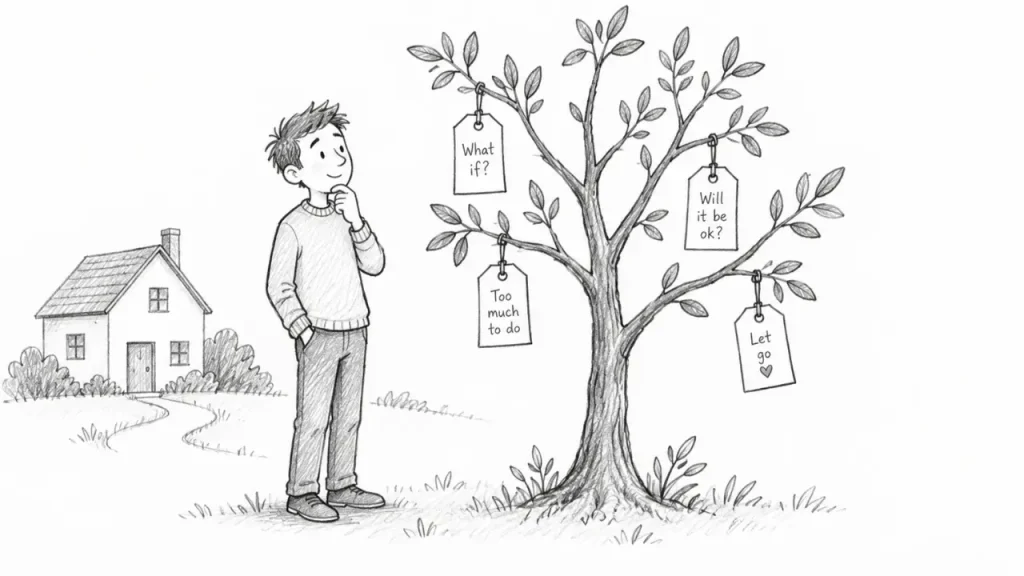
It’s called The Worry Tree.
Jump to a Section
- The Story of the Worry Tree
- What the Worry Tree Means
- Why I Share the Worry Tree During Coaching
- Most Worries Look Different in the Morning
- Try Your Own Worry Tree
The Story of the Worry Tree
A man hired a carpenter to help him restore an old farmhouse.
The carpenter had a terrible day.
First, a flat tyre cost him an hour of work. Then his electric saw stopped working. Finally, just as he was ready to go home, his old pickup truck refused to start.
The man who owned the farmhouse offered to drive him home.
During the journey, the carpenter sat quietly. It had clearly been one of those days where one thing after another seemed to go wrong.
When they arrived at his house, the carpenter invited the man inside to meet his family.
As they walked towards the front door, the carpenter stopped beside a small tree. He reached out and gently touched the ends of its branches.
Then something strange happened.
As he walked through the front door, his entire manner changed. He smiled, hugged his children and kissed his wife.
The frustrated and exhausted man from the journey home seemed to have disappeared.
Later, the carpenter walked his guest back towards the car. They passed the tree again and curiosity got the better of him.
“What did you do at that tree earlier?”, the man asked.
The carpenter smiled.
“That’s my worry tree,” he replied.
He explained that problems at work were unavoidable. Machines break. Things go wrong. People disappoint you.
Some days simply don’t go to plan.
But he had made a decision that those problems did not automatically deserve to walk through his front door with him.
So every evening when he arrived home, he imagined hanging his worries on the tree.
They could stay there overnight.
If he still needed them tomorrow, he could collect them again in the morning.
Then he added something interesting.
When he returned to the tree the following morning, there never seemed to be as many worries waiting for him as he remembered leaving there the night before.
What the Worry Tree Means
I like this story because it doesn’t suggest that our worries aren’t real. Some of them are very real indeed.
You might have missed your target, be facing a difficult meeting tomorrow, be worried about money, or have something going on at home that genuinely needs your attention.
The point of the Worry Tree is not to pretend those problems don’t exist.
It is to recognise that you don’t have to carry every problem with you every minute of the day.
There is an important difference between thinking about a problem and worrying about it.
Thinking can be useful when it helps us make a decision, solve something or take action.
Worrying is often what happens when we continue going over the same problem despite there being nothing useful we can do about it at that moment.
That is why worries can become so exhausting.
They create the feeling that we are somehow working on the problem, when in reality we are often just replaying it.
The Worry Tree is really about learning when to put something down.
It doesn’t mean the problem has disappeared. It simply means you have made a conscious decision that now is not the right time to deal with it.
Why I Share the Worry Tree During Coaching
One of the reasons I share this story so often during coaching sessions is that many people find it incredibly difficult to switch off from work.
I see this particularly often with salespeople and sales leaders because sales is a job that rarely feels completely finished.
There is always another prospect you could contact, another deal you could work on, another proposal you could improve or another piece of pipeline you could create.
When your performance is measured against a target every month, quarter and year, it becomes very easy for that pressure to follow you home.
Sales leaders often carry even more.
They are thinking about their own responsibilities while also worrying about the performance of everyone around them.
They may be thinking about who is behind target, which deals are likely to slip, whether the pipeline is strong enough, what senior management will say and which members of the team need support.
None of those concerns are necessarily unreasonable. The problem starts when there is no point at which they are allowed to stop.
I’ve had plenty of conversations during sales leadership coaching sessions where the real problem wasn’t somebody’s ability to do their job.
It was that their job had gradually started occupying almost every available part of their mind.
They might finish work, but mentally they never really leave it.
That is where I find the Worry Tree particularly useful. It creates a very simple pattern interrupt. Rather than telling somebody to “stop worrying”, which isn’t particularly helpful, it gives them a way of thinking about what they are carrying and whether they really need to carry it right now.
Something can still matter tomorrow without needing your attention tonight.
You Don’t Need an Actual Tree
You obviously don’t need an actual tree outside your house for this to work.
The value is in creating some kind of deliberate transition between work and the rest of your life.
For one person, that might be the drive home. For someone else, it might be closing the laptop, taking the dog for a walk, changing clothes or spending five minutes writing down what needs attention tomorrow.
The exact ritual doesn’t matter very much. What matters is that you make a conscious decision that the working day has ended.
Before you finish, it can help to ask yourself whether there is anything useful you can still do about the things you are worried about.
If there is, decide what action you are going to take. If there isn’t, write it down if necessary and leave it until tomorrow.
This can be particularly useful when there are unfinished tasks hanging over you.
Quite often, the reason we continue thinking about something is simply because our brain is trying not to forget it.
Writing the task down and deciding when you will deal with it gives your brain somewhere else to store it.
You are not avoiding the problem. You are choosing a better time to deal with it.
Most Worries Look Different in the Morning
For me, the most important part of the story is the carpenter’s observation that there never seem to be quite as many worries waiting for him in the morning as he remembers leaving on the tree the night before.
I think most people have experienced this in some form.
Something can feel enormous late at night, particularly when you are tired and there is nothing you can do about it. Then you wake up the following morning and it looks completely different.
Sometimes the problem is still there, but it feels more manageable. Sometimes you see a solution that wasn’t obvious the night before.
And sometimes the thing you were worrying about never happens at all.
A little distance can change your perspective. So can sleep, time and simply giving your brain a break.
I think we also have a habit of mentally jumping several steps ahead.
One small problem happens and within minutes we are imagining everything that could possibly go wrong as a result.
Most of those things never happen.
There is very little value in spending tonight worrying about a problem that tomorrow may never actually bring.
That is why learning to put worries down is not about ignoring problems.
In many cases, it actually puts you in a better position to deal with them properly when the time comes.
Try Your Own Worry Tree
The next time you finish a difficult day, try creating your own version of the Worry Tree.
Take a few minutes to think about what is still running around in your head.
Decide what genuinely requires action and what you are simply worrying about because you don’t yet know the outcome.
If something needs dealing with tomorrow, write it down. Decide what the next action is.
Then make a conscious decision to leave it there.
You don’t need to solve tomorrow’s problems tonight.
You are not walking away from your responsibilities. You are simply deciding that they do not need to occupy your mind every hour of the day.
That’s the lesson I take from the Worry Tree, and why I continue to share the story with people I coach.
There will always be problems to solve, targets to reach and things that don’t go according to plan. We cannot always control what gets handed to us during the day.
But we can become better at deciding what we carry home with us.
And when you return to your worries the following morning, you may find, just like the carpenter did, that there are fewer waiting for you than you expected.
About the Author
I’m David Craig White, a British B2B sales trainer, coach and consultant with more than 20 years’ experience helping sales teams get results.

When I’m not writing B2B sales articles, I’m providing B2B sales training, coaching and sales consulting to B2B sales teams, sales leaders and business owners.
👉 Subscribe to my sales success newsletter